The 15-minute mirror: how Hormozi and Dyrdek turned a timer into a fortune
Two self-made operators, the same low-tech habit of accounting for time in 15-minute blocks, and what it reveals about why most time tracking fails. Plus how Cronwatch makes the habit survivable.
Ask two people who have made a lot of money what actually moved the needle, and you might expect to hear about hustle, or a brilliant idea, or luck. Alex Hormozi and Rob Dyrdek give a stranger answer. Both of them point to a habit so dull it sounds like a joke. They wrote down what they did with their time, in small chunks, and then they looked at it.
Hormozi calls it the most productive thing you can do in a week. Dyrdek built an entire operating system for his life around it, and he credits it with hundreds of millions of dollars in exits. They landed on roughly the same unit of measurement, a quarter of an hour, and they'll both tell you the magic isn't in the tracking. It's in what the tracking does to you while you're doing it.
This is a post about that habit. What each of them actually does, why it works, and the one reason almost nobody sticks with it.
Hormozi's timer
Hormozi's version is almost insultingly simple. Here's how he describes it on his own LinkedIn, and in a widely shared video clip of the same method:
Make a Google sheet, really simple, and I want you to have the time slots from 5:00 AM to midnight, whatever, however long you work, in 15-minute increments.
 Hormozi laying out the method in his own words on LinkedIn.
Then you set a timer for fifteen minutes. When it dings, you write down what you just did. One or two words is enough. Reset the timer, do it again, and keep going all day for a week. At the end you read the whole thing back and audit it.
That's the entire method. No app, no projects, no tags. His pitch for it is basically a promise:
It will be the most productive week of your life, because you will be aware of how you're spending your time. Every time I do this...
And then he says something more useful than the technique itself. He admits he doesn't actually keep it running:
I immediately think I should do this all the time, and I don't. So just do it. Just do it for the one week, OK?
Hold onto that confession. We'll come back to it.
A quick note on sourcing, because this post tries to be careful about it. Those quotes come from Hormozi's short-form video and LinkedIn post, transcribed, so they're his words and his method but worth treating as very close paraphrase rather than letter-perfect. You'll sometimes see this exercise described online as "color-code each block green or red, tag every block with a dollar value." That part isn't his. His actual method is just track in 15-minute blocks, then review. The dollar-value thinking is real Hormozi material, but it comes from a separate teaching, which is where we're headed next.
Why it works: the mirror, not the spreadsheet
Hormozi's own explanation is awareness. You don't fix your week because a coach told you what's wrong. You fix it because the truth gets impossible to ignore once it's sitting there in writing.
There's a name for part of this. The reason it's the most productive week of your life while you're tracking, rather than after, is the observer effect. When you know you'll have to record what you did every fifteen minutes, you behave better in the moment. Measuring the thing changes the thing. (Our companion essay on measurement gets into the science here, including a 138-study meta-analysis of nearly 20,000 people that found monitoring your progress reliably improves it.)
The second half is what you do with the mirror once you have it. This is where Hormozi's bigger framework comes in, and the sourcing gets cleaner. It's laid out in his official Acquisition.com write-up and on The Game, episode 734. His point is that not all hours are worth the same:
Productivity is how much money you get out for the time you put in.
He splits his weeks into "maker" days and "manager" days, guarding long uninterrupted stretches for the work that actually compounds. And he's blunt about what he finds:
At the end of the month when I look back on what I actually accomplished, 100% of it is stuff I accomplished during maker time, not manager time.
He's just as blunt about what it costs to let people into those blocks:
It costs makers 10x more. A short meeting costs one measly work unit for the manager, and a giant work unit for the maker.
So the two halves fit together. The 15-minute audit is the diagnosis. It shows you, in your own handwriting, how little of your week actually goes to the few things that produce nearly all of your output. The maker and manager split is the prescription. You can't write the prescription until you've seen the mirror, and you can't see the mirror without measuring.
Dyrdek's Rhythm of Existence
Rob Dyrdek, the skateboarder turned Ridiculousness host turned founder of the venture studio Dyrdek Machine, took the same instinct and pushed it as far as it goes. He calls his system the "Rhythm of Existence." By his account it started as a 2015 spreadsheet and grew into a living manual for his whole life, somewhere between 50 and 80-plus pages, maintained with help from assistants, covering everything from travel logistics to date nights.
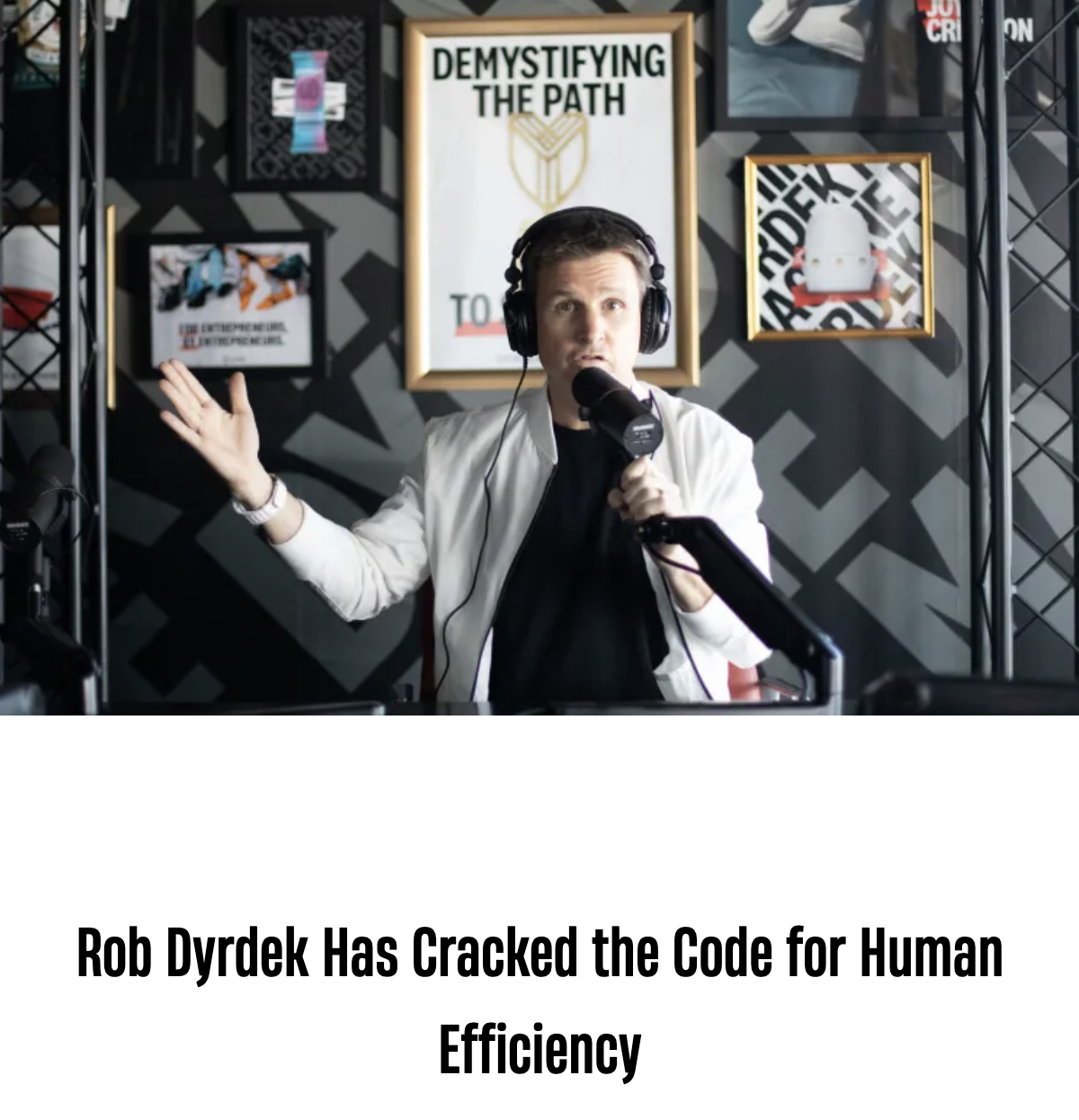 Dyrdek built his fortune on the same habit: account for every hour.
At the center of it is the same move. Account for your time. As he put it in InsideHook:
I'm someone that tracks every hour of the day, what I do every single hour.
His original practice was a color-coded Google Calendar, every block tagged to one of four pillars: Work, Family and Life, Health, and Sleep. An assistant exported it into a dashboard that produced monthly and quarterly stats. The increments got finer over time. The AI app he later built from the system, called Existence, works in 15-minute captures against the 168 hours in a week. His idea of a balanced day is roughly 7 hours of sleep, 7 of work, 7 with family and friends, and 2 on health, a target he checks against what actually happened to see if he's drifting.
On top of the numbers he keeps a feelings log. Every day, for years, he's rated his Life, Work, and Health on a 0 to 10 scale and written down why.
 The four pillars and the dashboard that turns a calendar into quarterly stats.
The results he ties to all this are not modest. The interview where he walks through the whole machine, My First Million episode 224, is framed around how tracking every second took him from zero to $405M in exits.
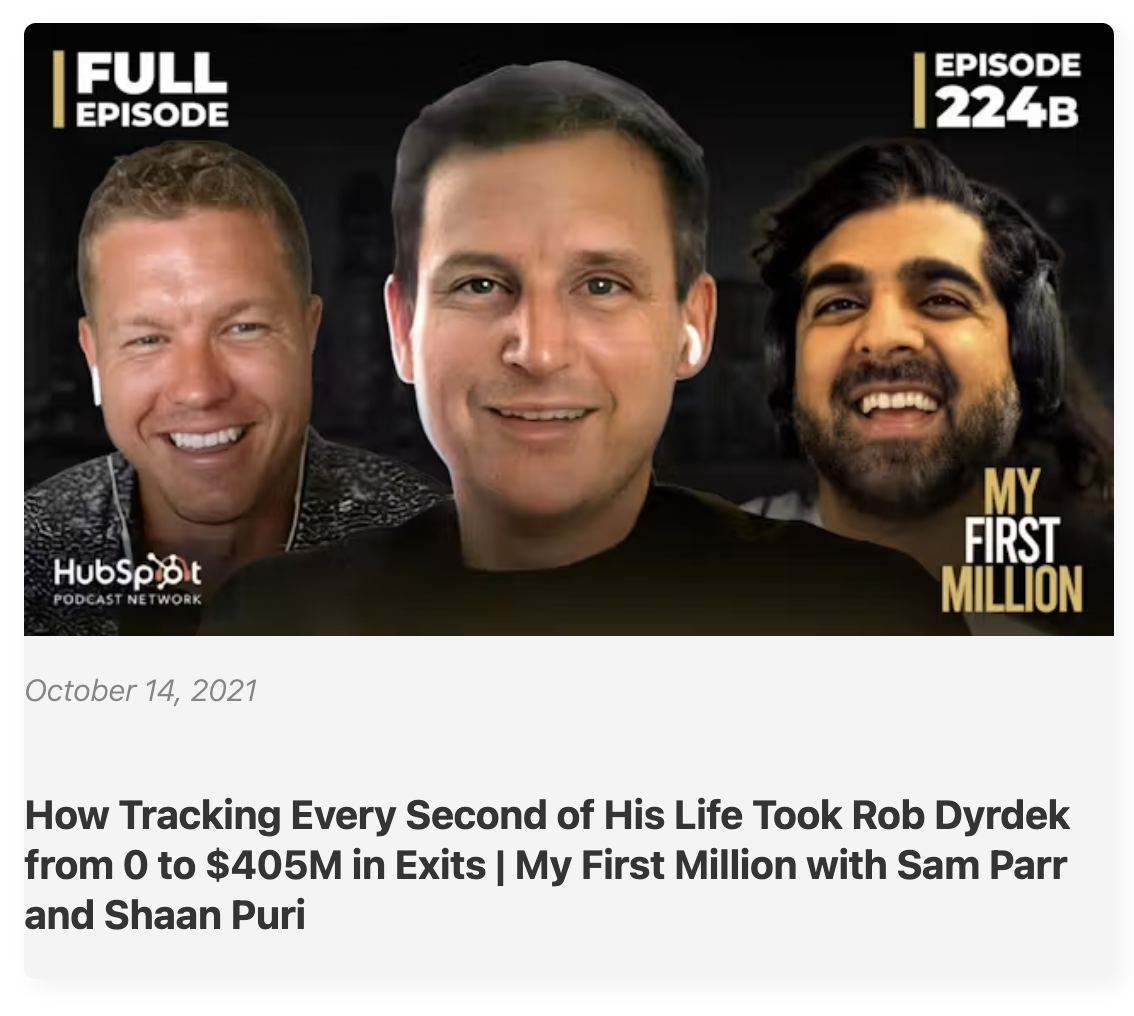 Dyrdek on My First Million, walking through how accounting for every second compounded into hundreds of millions in exits. The origin story is Ridiculousness. By measuring and re-engineering the process, he got filming an episode down from two or three hours to about 25 minutes, and went from shooting 2 episodes a day to 12, which freed up the time to build a portfolio of companies.
The part worth sitting with, though, isn't the money. It's the reason behind it. From the same interview (Podcast Notes summary):
I am human optimization, I'm optimized to be happy. Your goal is not to be happy in pockets, your goal is to be happy every single hour of your life.
His logic is the oldest argument there is for measuring anything. You can only optimize what you can see. Track your time and it gets obvious where you're wasting it and where you're starved. Balance, the way he talks about it, is something you build on purpose. It isn't something you hope for.
Two more accuracy notes, in the same spirit as the Hormozi caveat. The exit figure shows up as both $405M and around $450M depending on the source, so use whichever matches what you're citing. And the precise 15-minute increment is firmest for the modern app. His original personal system is better described as a color-coded calendar reviewed monthly and quarterly.
The same idea, twice
Set the personalities aside and you're left with one principle, reached independently by two people with very different lives.
First, account for your time in small blocks. Fifteen minutes is fine enough to catch where the time really goes and coarse enough that you can actually keep it up. Second, then look. The looking is the whole point. Measurement turns a vague feeling about your week into something solid you can act on.
Everything else, Hormozi's maker days, Dyrdek's four pillars and 0 to 10 scores, is stuff you build on top of the mirror once you've got one. Neither system works without the boring habit underneath it.
So why doesn't everyone do this?
Because of the one line Hormozi let slip. "I immediately think I should do this all the time, and I don't."
The 15-minute audit is brutal to keep up. A timer dinging every fifteen minutes all day, and stopping to type a note each time, is its own full-time interruption. Dyrdek can run a 50-page life operating system because, by his own account, he has two assistants and a chief of staff turning his calendar into dashboards. Hormozi runs his audit for one week and then stops, which he says plainly.
The habit works. The friction is what kills it. This is exactly the pattern we kept hitting when we built Cronwatch. Every time tracker dies the same death. You forget to start the timer, then you forget to stop it, and you've given up by Wednesday. The problem was never discipline. It was friction.
How Cronwatch makes the 15-minute habit survivable
Cronwatch turned out to be a pretty direct answer to what both of these guys are doing, minus the assistant and minus the willpower tax.
It runs on the same unit they landed on. Your day is a grid of 15-minute blocks, 96 rows from midnight to midnight. We're not claiming we invented that resolution. It's just where everyone serious about this keeps ending up, because it's the honest way to see a day.
The difference is how you capture. Instead of setting a timer and typing into a spreadsheet cell, you tap one button and say what you did. Something like "spent the last 45 minutes in deep work on the API, then fifteen on email." The app turns that into structured entries on the grid. No projects to set up, no tags to pick, no timer to remember to start or stop. The friction is about the friction of talking. Our internal bar is that if logging a block takes more than a couple of seconds, the habit is already dead.
That's the trick that makes the Hormozi and Dyrdek principle work for someone who doesn't have a chief of staff.
You get Hormozi's audit without the constant interruptions. No timer dinging every fifteen minutes. You speak a sentence when you finish a block, or catch up on a few in one breath later, and the grid fills in. The awareness effect survives. The overhead doesn't.
You get Dyrdek's pillars without the spreadsheet. Entries land in categories, and a weekly overview shows you the donut of where your hours actually went. It's your own version of his monthly dashboard, generated for you instead of by an assistant.
And the mirror stays honest. Empty blocks stay empty. There's no streak, no daily score, no productivity number to game. Cronwatch will show you that you spent six hours in meetings on Tuesday. It won't tell you whether that was good. You already know. (For why we deliberately refuse to gamify any of this, there's a section on Goodhart's Law in the companion essay.)
Hormozi is right that the audit can be the most productive week of your life. Dyrdek is right that accounting for your time is how you optimize a whole life, not just a quarter. The thing they're both quietly admitting is that the manual version is too heavy to carry for long.
That's the gap Cronwatch is built to close. Speak your time, see your day. The mirror that two self-made operators credit with their fortunes, finally light enough to keep in your pocket.
Get Cronwatch on the App Store
Sources
Alex Hormozi
- Hormozi, A. (2025). How you can manage your time like me for ultimate focus. LinkedIn. linkedin.com. His own description of the 15-minute Google Sheet audit.
- Hormozi, A. Hormozi's Timer: Simple Hack To Be Productive. YouTube. youtube.com. A clip of the viral 15-minute-timer method.
- Hormozi, A. This Simple Productivity System Made Me $100 Million, The Game, episode 734. Transcript, Apple Podcasts. Maker versus manager, and "100% of accomplishment in maker time."
- Hormozi, A. How I trade time for the most money. Acquisition.com. acquisition.com. The written maker and manager framework and the 10x cost of interrupting makers.
- Hormozi, A. Volume x Leverage = Output. LinkedIn. linkedin.com. The leverage and value-of-time reasoning.
Rob Dyrdek
- How Tracking Every Second of His Life Took Rob Dyrdek from 0 to $405M in Exits, My First Million episode 224. mfmpod.com, YouTube, Podcast Notes summary.
- Rob Dyrdek: The Man Who Tracks Every Second Of His Life, Modern Wisdom episode 636. Podcast Notes summary. The 0 to 10 daily scoring and "time is a canvas."
- Rob Dyrdek's Life Operating System, The Rhythm of Your Existence, Build With Rob, episode 64. YouTube. His own first-person teaching of the document and four pillars.
- Rob Dyrdek Has Cracked the Code for Human Efficiency. InsideHook. insidehook.com. The 7/7/7/2 day, the categories, and "perfectly balanced by design."
- Rob Dyrdek Announces Post-Ridiculousness Venture With Time Management App. Complex. complex.com. The Existence app and the Ridiculousness efficiency numbers.
- Starting a Life Operating Model. Path To Warren. pathtowarren.com. The 50 to 80-plus page document, the pillar split, and weekly cadence.
Cronwatch
- Gnat, K. (2026). You can only improve what you measure. Cronwatch blog. The science of self-monitoring and why Cronwatch refuses to gamify it.